Buying a custom outdoor tent sounds simple until you actually start comparing sizes, frames, fabrics, printing options, walls, accessories, and prices. Suddenly, what looked like “we just need a tent” turns into a surprisingly serious business decision.
And that is not necessarily a bad thing.
For companies that regularly attend trade shows, farmers markets, sporting events, festivals, product launches, community fairs, or outdoor promotions, a tent is much more than shade. It becomes a mobile storefront, meeting space, advertising surface, and brand landmark all at once.
The right tent can make your company look established and easy to recognize. The wrong one can look tired after a few events, create setup headaches, or make your booth disappear into a sea of nearly identical shelters.
So how do you choose wisely? Start by thinking about your event goals before you think about the price tag.
Table of Contents
Start With What the Tent Actually Needs to Do
Before searching through custom tents for sale, decide what will happen underneath your tent.
Will you be selling products? Giving samples? Holding consultations? Registering participants? Demonstrating equipment? Displaying merchandise? Collecting leads?
Those activities determine almost everything else.
A business that sells packaged food at markets may need open access across the front, storage toward the rear, and enough counter space to serve customers quickly. A home-services company may need walls for project photography and a quieter area for consultations. A fitness brand may want an open center where visitors can participate in demonstrations.
Your tent should support the customer experience instead of forcing the customer experience to work around the tent.
Size Matters, but Bigger Is Not Always Better
Event tents come in many footprints, and the temptation is often to buy the largest one the budget allows.
That can be unnecessary.
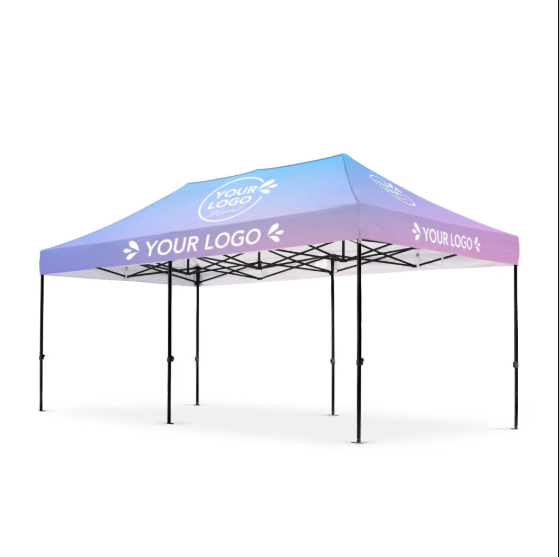
For many businesses, a custom pop up canopy 10×10 is an excellent starting point. The 10×10 footprint is familiar, versatile, and suitable for many standard vendor spaces. It offers enough room for tables, staff, products, and basic storage without becoming difficult to transport.
It also works well for businesses that attend events with strict booth dimensions.
A larger tent can make sense if you need multiple activity zones, significant inventory, seating, or demonstrations. But if the event only gives you a 10×10 space, owning a giant structure will not magically persuade the organizer to move the neighboring vendors.
Choose size based on realistic use, not optimism.
A Farmers Market Brand Finds the Right 10×10 Formula
Imagine a specialty salsa company attending farmers markets every weekend.
The team originally used a generic white tent, folding table, handwritten signs, and a growing collection of clips trying heroically to keep everything attached.
Customers liked the product, but the booth looked temporary and was difficult to recognize from one market to the next.
The company invested in a 10×10 tent custom setup with its logo printed prominently on the roof, product categories on the valance, and a branded rear wall.
One narrow counter handled samples. A second side table displayed jars, while inventory stayed organized beneath the surfaces.
The footprint remained exactly the same, but the booth looked much more professional. Returning customers could spot the brand from farther away, and employees no longer spent the first part of every market wrestling with temporary signs.
That is the value of customization: the tent stops being generic equipment and starts working as part of the brand.
Frame Quality Should Come Before Fancy Extras
Custom graphics get attention, but the frame is what keeps everything standing.
When comparing custom tents for sale, look closely at frame construction, leg strength, truss design, fittings, adjustment mechanisms, and the availability of replacement parts.
Businesses that attend events frequently will put the frame through repeated setup, breakdown, transportation, and storage. That routine adds up.
A low-priced tent can seem attractive until the frame starts sticking, bending, or loosening after repeated use.
That is why commercial buyers should think in terms of durability rather than simply initial cost.
A higher-quality custom outdoor tent may cost more because stronger materials and dependable components cost more to manufacture. If that tent performs reliably across dozens of events, however, the cost per event may be far more attractive than a cheaper structure that needs early replacement.
The Fabric Is Part Shelter, Part Billboard
Canopy fabric has two major jobs.
It needs to function as part of the shelter, and it needs to carry your brand professionally.
When comparing options, review fabric specifications, manufacturer care instructions, printing methods, and outdoor performance. Do not assume every canopy fabric behaves the same simply because the tents have similar dimensions.
Printing quality is particularly important for branded businesses.
Your logo might look perfect in the design file, but that means little if the final colors look weak or the graphics deteriorate quickly.
A professional tent should make your brand look intentional, not as though someone enlarged a low-resolution logo five minutes before the event.
Keep Your Branding Clear From a Distance
The best branded tents are rarely the ones with the most text.
At an outdoor event, visitors may see your booth from thirty or fifty feet away. They need to understand who you are quickly.
Use the roof for strong visual recognition. Large logos, recognizable colors, and uncluttered designs are usually more effective than paragraphs of copy.
Valances can provide a little more detail, such as a tagline, website, or short description of your business.
Walls can carry product photography, service categories, promotional messages, or visual storytelling.
Think in layers. The roof gets attention. The valance provides context. The interior provides detail.
A Home Improvement Company Turns Its Tent Into a Portfolio
Consider a remodeling company attending a regional home show.
The business sells projects that are difficult to demonstrate physically. It cannot exactly bring a new kitchen, bathroom, and deck into the parking lot.
Instead, the company uses a custom outdoor tent as a mobile project gallery.
The roof features the company logo and colors. One wall displays large before-and-after photographs. Another highlights key services. A small consultation table sits toward the rear where staff can speak with homeowners.
The tent helps visitors understand the company before the salesperson begins talking.
That is especially important for service businesses. A professional branded environment can make an intangible service feel more credible, organized, and established.
Choose Walls Based on Function, Not Decoration
Sidewalls can transform the way a tent works.
They can provide additional branding space, define the interior, create privacy, help separate staff areas, or support product displays.
But walls should serve a purpose.
If your customers need easy access from several directions, closing the tent on three sides may make the booth feel uninviting. If you need privacy for consultations, full walls may make perfect sense.
Half walls can be useful when you want a defined boundary without completely closing the space.
The right configuration depends on customer behavior.
A custom pop up canopy 10×10 used for sampling might stay mostly open. The same size used for appointment booking could benefit from a more enclosed layout.
Think About Transportation Before Event Day
A fantastic tent is considerably less fantastic if your team cannot comfortably move it.
Before buying, consider the packed dimensions, weight, storage bag, vehicle space, and number of people who will normally handle setup.
A small team attending several events every month may prioritize portability more heavily than a large event crew with dedicated transport.
This is where balance matters.
You want equipment strong enough for frequent commercial use but practical enough for your staff to manage.
A quality 10×10 tent custom solution can often provide a good middle ground for businesses that need professional presentation without complicated event logistics.
A Fitness Brand Creates a Portable Membership Hub
Picture a fitness studio attending races, wellness fairs, and community events.
The company wants to attract new members, promote classes, distribute trial offers, and collect contact information.
A custom pop up canopy 10×10 gives the studio enough room to create a compact promotional hub.
The roof carries bold branding that matches the studio’s signage. One side features class information, while the rear wall promotes membership offers. A small counter handles sign-ups, and the remaining space stays open for staff to talk with visitors.
Because the setup is portable, the same team can use it at several events without needing complicated installation.
The studio gains consistent branding, a recognizable meeting point, and a professional space for customer conversations.
Do Not Let Price Become the Only Deciding Factor
It is completely reasonable to compare prices when looking at custom tents for sale.
What businesses should avoid is assuming the cheapest option automatically delivers the best value.
Commercial event equipment takes abuse.
It gets packed into vehicles, rolled through parking lots, set up on uneven surfaces, exposed to outdoor conditions, packed away again, and stored until the next event.
That process may happen dozens of times every year.
Higher-quality tents often cost more because the frames, fabrics, fittings, printing, and construction are designed to deliver stronger long-term performance.
If a lower-cost tent needs frequent repairs or early replacement, the apparent savings can disappear quickly.
Think about the number of events you plan to attend and calculate the cost over time.
A premium tent used successfully across many seasons can be a smarter investment than buying cheaper equipment repeatedly.
Your Brand Reputation Is Standing Under the Tent
Quality is not only about durability.
It is also about appearance.
Customers may not inspect the frame specifications, but they will notice faded graphics, sagging fabric, damaged hardware, or a booth that looks poorly maintained.
Your event tent is part of your temporary storefront.
If your business sells premium products or services, the equipment surrounding those products should support that position.
A high-quality custom outdoor tent communicates that the company pays attention to presentation and expects its equipment to perform professionally.
That visual impression is especially important at competitive events where several businesses may offer similar products.
Build for Several Campaigns, Not One Weekend
Custom printing is most valuable when the design remains useful.
Keep permanent graphics focused on evergreen branding such as your company name, logo, core colors, primary service category, and long-term message.
Avoid covering the entire structure with dates, temporary offers, or campaign-specific pricing that may become outdated quickly.
Instead, use removable banners, signs, or interchangeable accessories for short-term promotions.
This allows the same 10×10 tent custom setup to support a spring trade show, summer festival, fall market, and holiday promotion.
The more events one tent can support, the stronger its long-term value becomes.
Accessories Should Solve Problems
Tables, counters, flags, sidewalls, banners, storage systems, and printed table covers can all improve a booth.
The key is choosing them because they solve a real problem.
A branded table cover can turn an ordinary folding table into part of the display. A rear wall can hide storage while carrying graphics. A half wall can guide customer traffic. A counter can create a clear point for transactions.
Accessories should make the custom outdoor tent easier to use, easier to understand, or more professional.
If an accessory adds clutter without improving the customer experience, it probably does not belong in the booth.
Make the Tent Work as Hard as Your Team Does
The right custom tent should make events easier, not more complicated.
It should help customers find you, give staff a practical place to work, present the brand consistently, and perform reliably across repeated use.
For many businesses, a custom pop up canopy 10×10 offers the ideal combination of portability, branding space, and event-friendly dimensions. Other companies may require a larger footprint, additional walls, or different configurations.
Whatever you choose, prioritize quality.
Premium commercial tents may cost more upfront, but stronger construction, durable fabrics, professional printing, and dependable components can provide better long-term value for businesses that attend events regularly.
Explore high-quality custom tents for sale, branding options, printed walls, accessories, and professional event solutions that match how your business actually operates.
A great tent should do more than keep the sun off your team. It should help customers recognize your company, trust your presentation, and remember your brand after the event is over.
When you choose carefully, your tent stops being another piece of equipment in the storage room. It becomes one of the hardest-working pieces of marketing you bring to every event.